
Every time Gmail moves junk mail to spam or Netflix suggests a show you end up loving, machine learning is working quietly in the background. It’s one of the most useful parts of artificial intelligence and also one of the most misunderstood.
This guide explains machine learning in plain words: what it is, how it works, the main types, and where you already use it every day.
What Is Machine Learning?
Machine learning (ML) is a way of teaching computers to learn from data instead of giving them step-by-step rules. The term goes back to 1959, when Arthur Samuel, a researcher at IBM, built a checkers program that got better the more games it played.
The idea is simple. You show the computer many examples, it finds the pattern on its own, and then it uses that pattern on new data it has never seen.
Take spam emails. The old way was to write rules, like “if the email says lottery, mark it as spam.” Spammers just changed their words and the rules broke. With machine learning, you feed the system thousands of emails already marked as spam or not spam. It learns what spam usually looks like, and it keeps getting better as new examples come in.
How Does Machine Learning Work?
Most ML projects follow the same four steps.
- Collect data. This could be past emails, sales numbers, photos, or customer clicks. The quality of the data matters more than people think.
- Train the model. The algorithm studies the data and looks for patterns. The result is called a model.
- Test the model. You check it on data it hasn’t seen before. If it only does well on the old data, it hasn’t really learned anything useful.
- Use it and improve it. Once it works well enough, you put it to use. Then you keep feeding it fresh data so it stays accurate.
Here’s a small example. Say you want to predict house prices. You give the model data on 10,000 houses: size, location, age, and the price each one sold for. After training, you give it a new house it has never seen, and it guesses the price based on what it learned.
Types of Machine Learning
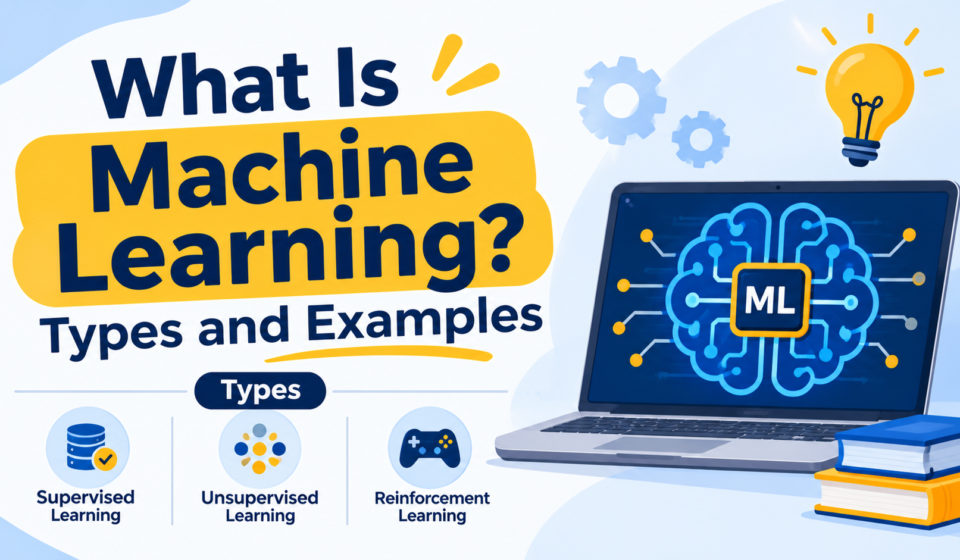
There are four main types. The difference is in how the model learns.
| Type | What the data looks like | Goal | Example |
|---|---|---|---|
| Supervised learning | Labeled (the right answer is given) | Predict a known outcome | Spam or not spam, house prices |
| Unsupervised learning | Unlabeled (no answers given) | Find hidden groups or patterns | Grouping customers by buying habits |
| Semi-supervised learning | A small labeled set plus a large unlabeled set | Learn well when labeling is costly | Sorting medical images with few labeled scans |
| Reinforcement learning | No data up front, it learns by trying | Maximize a reward | A program learning to play a game |
1. Supervised Learning
This is the most common type. The model learns from examples that already have the correct answer, like a student working through a textbook with an answer key. It has two main jobs:
- Classification: put things into categories. Is this email spam or not? Is this transaction fraud or normal?
- Regression: predict a number. What will this house sell for? How many units will we sell next month?
2. Unsupervised Learning
Here there are no answers. The model just looks at the data and finds structure by itself. The most common job is clustering: grouping similar things together. A store might use it to find that its customers fall into three groups: bargain hunters, regular buyers, and big spenders. Nobody told the model those groups existed.
3. Semi-Supervised Learning
Labeling data takes time and money. In semi-supervised learning, you label a small part of the data and let the model figure out the rest. It’s a middle path between the first two types.
4. Reinforcement Learning
The model learns by trial and error. It takes an action, gets a reward or a penalty, and slowly learns which actions lead to better results. Think of training a dog with treats. This is how programs learn to play chess or Go, and how some robots learn to walk.
Common Machine Learning Algorithms
You don’t need to master these on day one, but you’ll hear the names often:
- Linear regression: predicts a number from other numbers
- Logistic regression: predicts a yes or no answer
- Decision trees and random forests: make decisions by asking a series of questions
- K-means: a popular clustering method
- K-nearest neighbors (KNN): classifies something based on the items most similar to it
- Support vector machines (SVM): draw the best line between two groups
- Neural networks: loosely inspired by the brain, and the base of deep learning
Real-Life Examples of Machine Learning
You probably used machine learning several times today without noticing.
- Email spam filters: Gmail and others sort junk mail automatically.
- Recommendations: Netflix, YouTube, and Amazon suggest things based on what you and people like you have watched or bought.
- Fraud detection: Banks and UPI apps flag unusual transactions in seconds.
- Maps and traffic: Apps like Google Maps predict travel time using past and live traffic data.
- Healthcare: Models help doctors spot problems in X-rays and eye scans.
- Voice assistants: Alexa, Siri, and Google Assistant use ML to understand what you say.
Machine Learning vs AI vs Deep Learning
People use these three words as if they mean the same thing. They don’t.
- Artificial intelligence is the big idea: making machines do things that normally need human intelligence. If you’re new to this, start with our guide on what is artificial intelligence.
- Machine learning is one way of building AI by learning from data.
- Deep learning is a part of machine learning that uses neural networks with many layers. It powers image recognition and tools like ChatGPT.
A simple way to remember it: deep learning sits inside machine learning, and machine learning sits inside AI. We break this down further in the difference between AI, machine learning, and deep learning.
Common Mistakes Beginners Make
These are the problems that trip up almost everyone at the start.
- Believing more data always fixes things. Bad or messy data gives a bad model, no matter how much of it you have.
- Overfitting. The model memorizes the training data instead of learning the pattern, so it fails on new data. Always test on data the model hasn’t seen.
- Data leakage. Information from the test data accidentally slips into training. The results look amazing, and then fall apart in real life.
- Trusting accuracy alone. Imagine only 1 in 100 transactions is fraud. A model that says “not fraud” every time is 99% accurate and completely useless. Look at precision and recall too.
- Jumping to deep learning too early. Learn simple models like linear regression first. They teach you how the whole process works.
How to Start Learning Machine Learning
You don’t need a PhD. A realistic path looks like this:
- Learn basic Python.
- Pick up the basics of statistics, probability, and a little linear algebra.
- Get comfortable with NumPy and pandas for handling data.
- Use scikit-learn to build simple models.
- Do small projects: predict house prices, build a spam classifier, or group customers. Free datasets on Kaggle are a good place to practice.
If you want structure, mentor support, and projects in one place, a machine learning course can save you a lot of trial and error.
Conclusion
Machine learning is just computers learning from examples instead of following fixed rules. Supervised learning predicts known answers, unsupervised learning finds hidden groups, semi-supervised learning mixes the two, and reinforcement learning learns from rewards. It already runs the tools you use every day, from spam filters to maps.
The best way to learn it is to build small things early and make mistakes on purpose. To see where machine learning fits in the bigger picture, go back to our hub guide on what is artificial intelligence, and when you’re ready for the next step, read about deep learning.
FAQs
-
What is machine learning in simple words?
It’s teaching a computer to learn from examples, so it can make predictions or decisions on new data without being given a rule for every case.
-
Is machine learning the same as AI?
No. AI is the wider goal of making machines act intelligently. Machine learning is one way to reach that goal, by learning from data.
-
Do I need to know coding to learn machine learning?
Basic Python is enough to start. Some no-code tools exist, but coding gives you far more control and is expected for most ML jobs.
-
What are the four types of machine learning?
Supervised, unsupervised, semi-supervised, and reinforcement learning. They differ in the kind of data the model gets and how it learns from it
-
How long does it take to learn machine learning?
Most beginners need around four to six months of steady practice to get comfortable with the basics. Becoming job-ready usually takes longer and depends on how many real projects you build.